Although no one has formally commented on the blog yet, and please let nothing stop you from doing so, I do get emails from friends who say "Why are you watching such obscure trash? I have never heard of the last five movies you wrote about. Where the hell is [insert movie everyone knows]?"
The answer, of course, is this: That's what's on TV! I cull most of my picks from a handful of channels that play '80s movies with some regularity - most often, MGM and Encore with a sprinkling of other channels. I also tend to prioritize movies I may never see again - I'll always be able to find E.T., but when will Slaughter High come around again?
That said, tonight I'm covering possibly the most beloved single film of the entire decade and its fairly well-liked sequel: Back to the Future and Back to the Future II, released in '85 and '89 respectively. I would cover the third installment (which I actually detest, and hated from the day I saw it as a kid in the theaters) except it snuck across the border into the No Man's Land of the '90s (even though it was filmed back-to-back with number two).
So, here we are. The first movie, of course, is a mega blockbuster (8th highest grossing in the decade) and is also completely saturated in the '80s - the look, the ideas, the actors, everything. For the uninitiated, here is the basic rundown. Our protagonist Marty McFly is played by Michael J. Fox, known best at the time the move was released from his iconic role as Alex P. Keaton on the huge TV hit show Family Ties.
Now, I love Michael J. Fox. I like him as much in his duds (Light of Day; The Hard Way) as in his hits (Back to the Future series; Teen Wolf; Doc Hollywood). But I freely admit he largely plays the exact same personality in each movie. I'd estimate about 85% of every role is just his natural perky wise-ass personality with the squeaky voice and 15% is whatever character he's supposed to be.
Luckily that is a good thing here. In this movie, director Robert Zemeckis (Romancing the Stone; Who Framed Roger Rabbit?; Forrest Gump; Cast Away) uses Fox to absolutely maximum potential. Just maxes him right out. It's like the role was written just for him. And it shows: the movie made $383 million in combined theater and rentals.
Here's the plot: Marty McFly (which is just a great freaking name) lives in Hill Valley, California. His dad (the immortal Crispin Glover in his most famous role) is a wimp, his mom (the sexy Lea Thompson at her peak of fame) is a lush, and his dad's boss Biff (played by the fantastically hateable Thomas F. Wilson) is a horrific bully. Luckily, Marty has an escape: he is good friends with mad scientist Emmett "Doc" Brown, played by Christopher Lloyd in what is probably his most recognizable role. It's either this or Taxi, take your pick.
Doc Brown meets with Marty in the parking lot of a mall to show him his newest invention: A TIME MACHINE. This is, of course, the most '80s touch of them all - time machines were a BIG topic back then. Movie from '80s featuring time travel include:
- Star Trek IV
- The Philadelphia Experiment
- Bill and Ted's Excellent Adventure
- Trancers
- Flight of the Navigator
- The Terminator
- Time Bandits
- Young Sherlock Holmes
- The Final Countdown
- Peggy Sue Got Married
- Somewhere in Time
- Cocoon (sort of)
- Howard the Duck (sort of)
and I'm sure more that I'm forgetting. Time After Time only missed by one year, being from '79. It's a helluva list.
I'm not sure why the time travel motif blew up so much in the '80s, but it sure did. And this movie is the undisputed king of them all; the time travel is the main conceit and is also hovering in the background waiting to emerge again and twist things once more when you least expect it.
Getting back, Doc Brown has not only created a time machine, but he has immortalized it in one of the most '80s of all automotive icons: The DeLorean DMC-12. The car is INCREDIBLE. The gull wing doors, the unpainted stainless-steel finish, the wedge nose shape, everything about it screams 1980s. The only other car I might consider would be the Ferrari 308 GTSi that Tom Selleck rocks in Magnum P. I.
OK, so the DeLorean has a time machine for a power plant ("1.21 Gigawatts!"). Unfortunately, to power the machine Doc Brown has stolen plutonium from terrorists ("Libyans!"). They hunt him to the parking lot and gun him down - Marty uses the car to escape and travel back to 1955 ("88 miles per hour!") and set things right. Unfortunately this actually creates several more problems - he meets his young mother, who falls for him (!) at the expense of his future father (!!), and he is trapped in 1955 until a young Doc Brown can figure out how to generate the 1.21 gigawatts needed to get back to 1985.
As Marty attempts to set his parents back up, fix his time machine, ward off the horrendous bully Biff, and save future Doc from the terrorists, he discovers that as he alters the past, he alters the future. In an ingenious twist, as he changes events people in the photos he has from the present begin to fade out of the photograph - out of existence. Even he is eventually imperiled and begins to fade out. As a kid I found this mesmerizing and it adds a real sense of urgency and compulsion to the whole movie. There is always a clock ticking and Marty is under a lot of pressure to get everything done.
The immortal theme, done by Alan Silvestri, is very exciting and memorable. The plot is clever and intermixes the '50s and '80s with great effect - kudos to writer/producer Bob Gale, who surprisingly did not write many other movies outside the Back to the Future universe. It's too bad; of course, with the success the franchise, he is probably rich beyond counting and doesn't need to write anything else. He's probably being carted around in a platinum hovercraft right this moment.
I don't want to write much more, or else I will spoil the movie entirely for anyone who hasn't seen this yet. Instead, I'll move on to the sequel, made four years later. I was nine when the second movie was released and remember vividly that it was released sometime in the autumn, and was almost as big a hit as the original, and that it spawned more talk among my friends than any other movie. Everyone was talking hoverboards and holograms and whatnot.
The premise is that Doc comes back to 1985 from 2015 and says that Marty has to go to the future with him to save his future children. Marty does so, and successfully defeats Biff's grandson Griff. However, their departure is witnessed by Biff, who sees Marty again in 2015 as an old man, and which sets into motion a long chain of events that leads to Future Biff taking a sports almanac back to 1985, betting on various sports events and becoming the richest man in the world... much to the detriment of the McFly clan.
The second movie is a lot more gimmicky than the first, and very honestly, is about 3/4 as good. The plot isn't as tight, the characters are more broad (and therefore less focused and interesting), and the whole thing feels less urgent - maybe because the idea isn't as new anymore. The neatest thing the second movie comes up with is its dystopian view of the Biff-centric future, which is really decayed and horrifying in that neon tech-noir '80s way.
When I was growing up I had a number of friends who preferred the second movie to the first one - but I think this has to do with being older when it came out and the stronger memories it generated. I've never met anyone, and probably never will, who prefers the botch-job of the third movie, which takes place in the Wild West and has approximately one successful joke per hour. Approximately.
So it's really the first two, and especially the first one, that shines. The first movie just gets everything right - the look, the gags, the characters, the actors, the music, the pacing, the works. It's perhaps semi-famous for the best screening of any movie in Hollywood - usually they preview a film and the audience hates something and the producers change something and so on. Not here - the audience blew up in a frenzy of adoration.
I'm not sure what other bases to cover here. There was a mass production of merchandising tie-ins, very common, but I really only remember the atrocious Nintendo game. There was a cartoon, I think, and maybe another related TV version, but I remember neither very well. What I would be most interested in knowing is what later movies were directly influenced by the series - anyone know? Can think of any characters drawn straight from Doc Brown and Marty McFly? The fading polaroid effect? Etc.? Any input most welcome.
Yes, that's absolutely a dollar sign in the title of How to Beat the High Co$t of Living (1980). Dollar dollar bill y'all. This movie is one of the first I saw (along with Private School and Slaughter High) after I decided to tackle every single movie in the whole damned decade.
This movie is very fun and also interesting in one specific and unexpected way. First, as everyone knows, the first couple years of any decade "feel" a lot like the previous decade... and the last couple tend to predict the upcoming one. So movies from 1980 should, in theory, seem a lot like movies from 1979. It's not like the whole industry passes around a memo saying "New decade, new rules!" and everyone forgets that Alien and Apocalypse Now and The Muppet Movie ever happened and starts anew.
Except this movie DOES feel like that. This is the earliest movie I've seen for the blog that feels concretely in the 1980s. I don't know how to describe it beyond saying that it looks exactly like I remember my small hometown looking in the early '80s. It was a real nostalgia trip.
The movie is about several women who are having relationship problems - divorced, abandoned, or in one case sued (!) by her husband. They find single life is no peach, and have a tough time making ends meet... until they gather their talents and wits and decide to rob a mall on Christmas during the drawing for a huge cash prize. Brilliant!! I wish I had thought of it. The modern equivalent might be tunneling into McDonalds headquarters to steal the fabled Boardwalk Monopoly piece. In ten years that sentence is going to seem really dated.
The women are all played by good actresses: Susan Saint James, Jane Curtin (film debut!), and Jessica Lange. The men are also pretty well known - Fred Willard, Eddie Albert, Dabney Coleman (who is great as a lonely cop). I enjoyed each and every one of them - they all seem like genuine people, good hearts and big problems and making the best of things using what they got.
They are also funny - this movie has a few legitimate laugh-out-loud moments, like when one couple attempts to have sex in their car on a date, like teenagers might, and the woman's foot gets stuck in the glovebox... and they have to petition loudly for help from the other residents parked on Lover's Lane... with some unexpected consequences.
They women all become enormously empowered by their new scheme. It's a lot of fun to watch these ladies get the upper hand on all the jerks and deadbeats who have aggrieved them. Of course, the plan goes awry in hilarious (and breast-baring!) fashion, but they roll with the punches and make the best of it.
Meanwhile, Private Benjamin (1980) is another tale of female empowerment. This is another very common motif in '80s movies - See Tootsie, 9 to 5, Shirley Valentine, She Works Hard for the Money, The Legend of Billie Jean, hell, even Haley in The Wizard. There are a lot, and most are good.
This one I reviewed mostly as a tribute to the memory of Eileen Brennan, who just passed away. She plays the wonderful Captain Doreen Lewis, who is more or less in charge of of shaping our heroine Judy (my second favorite role for Goldie Hawn, after Overboard in '87) into a lean, mean Army machine.
Judy is a pampered, spoiled trophy wife whose husband dies in the marital bed, leaving Judy purposeless and adrift. She hears an ad for the Army on the radio, likes the message of self-sufficiency and structure and discipline, and joins.
At first, of course, she is a wimp and almost washes out. The scene where they have to cut her loose from the razor wire atop the camp fence is very funny. When her parents come to claim her and insult her independence and dignity, she draws a line and commits to become an Army of One. And damned if she doesn't do it. I particularly liked when overcomes her fear of jumping from the plane ... with some funny encouragement from the paratrooper officer.
The movie is obviously not overly real (readers? anyone? Please tell me this isn't how basic is conducted...) but is a lot of fun. As a comedy, it works. The bit actors really sell their roles, and the pacing is fast and quick - just as a light comedy should be. Worth watching!
Private Benjamin was directed by Howard Zieff, who is most notable for the two My Girl movies. He also made the underrated Slither (1973), a great James Caan / Peter Boyle vehicle about an unconventional group of two-bit crooks searching for a small fortune.
Final note: I chose that poster for the movie because of that great title: La Bidasse. Someone please tell me that means The Bad-Ass!!
 The Witches of Eastwick (1987) is one of the first "heavy hitters" here on the blog. By that I mean the movie was promoted heavily to mainstream America, and was successful. IMDB indicates it made a combined $100 mil in theater and video rentals. I don't know how much it cost to make, but I am sure it was a lot less than that.
It also has Big Time Big Name actors - Nicholson! Cher! Sarandon! Pfeiffer! And it shows - the movie is very highly polished. The general plot is that the Devil (played by Nicholson) comes to a small town and seduces three women who have small magical powers. His general plan seems to be to have them all give birth and thereby bring about the end of the world.
Each woman has a distinct personality, and watching Nicholson adopt a new persona to seduce each one is fairly fun. Nicholson really chews up the scenery, and he has a few great speeches, especially the one on Women in the church near the end.
It's also interesting to see Veronica Cartwright (who I know best from Alien) as the churchy woman in town who is punished for seeing through the devil's facade and calling out the witches. In Alien she is the first to panic, the first to collapse into extreme fear in the face of the unknown. Here she is the opposite - the stalwart Old Testament believer who refuses to accept the presence of evil in her community.
It's based on the book by John Updike, although it changes the plot somewhat. The book is known as a somewhat pro-feminist novel, but the movie is even more so. The women fall once each for Old Scratch, but absolutely get the better of him in the end.
The movie has a couple set pieces worth mentioning: the first is the tennis match, where the women each finally discover their powers when the game gets intense and they cause a tennis ball to start levitating. I found it kind of boring, but then I learned something interesting - the tennis ball was completely animated by Industrial Light and Magic! You would never, ever know. I figured the levitation effects were just normal fx, camera tricks, etc. It's impressive that CGI could accomplish that in 1987.
The other is the great scene where the bible thumper, enemy to the witches, finally meets her end - by endlessly vomiting cherry pits until her husband puts her out of her misery with a fire poker (!!). It's a surprisingly graphic and nasty scene, and feels very raw.
Meanwhile, Night of the Creeps (1986) is a movie I liked in a goofy kind of way despite being unpolished in every way. The plot is kind of a mash-up of several different genres:
Aliens, who look like men in giant misshapen E.T. suits, open the film by allowing a horrible experiment to escape their ship and come crashing to earth. The experiment is basically a group of gross leeches/slugs/leechslugs who jump in your mouth and live in your brain. Then once you die, they animate your body until they can find a new host.
So far, so good. But the catch is that the movie plays at being a teen slasher movie too. So it's a sci-fi/horror/teen slasher/detective movie. The detective part kicks in when the police start trying to figure out how to stop the sluggos.
The title comes from the best scene in the whole movie: the fraternity sorority prom night. A cop busts through the main door of the sorority house and barricades it shut. The girls complain - who are you? What in hell do you think you're doing?
The cop says: "I have good news and I have bad news. The good news is that your dates are here. The bad news is that they are dead."
With those immortal lines begins a really fun sequence where the cop detective, our two nerd heroes, and a house full of fully decked out sorority girls all help fight off the leechies. It's very well managed and I really enjoyed it.
Sadly, the movie appears to have bombed horribly. IMBD reports it cost $5 mil to make and only brought back a tenth of that. It was directed by Fred Dekker, who also made the '80s classic The Monster Squad, famous for the line "Wolfman's got NARDS!" He apparently also made Robocop 3. I didn't even know they made a third one ... not a good sign.
This poster for Private School (1983) really tells it all. Preppie guy and preppie girl are just about to fall in love when they are rudely interrupted by a trio of horny, crossdressing, wolf-whistling teen boys while a small army of private school girls moon them disrespectfully from below.
Isn't that how we all fell in love the first time? Plus, please check out the GIANT books the boy is sitting on - he must have the world's best collection of world atlases.
Private School is a quirky and totally memorable T&A teen movie from the early '80. "T&A" movies (tits and ass) have always been with us, but really blew up into a whole genre of money-making juggernauts with the enormous and unexpected success of director Bob Clark's infamous movie Porky's (1982).
Porky's opened the floodgates: Malibu Bikini Shop, Hot Dog, Hollywood Hot Tubs, Bikini Summer, Amazon Women on the Moon, and so many, many more ... including Private School.
In this iteration, a very young Matthew Modine falls for a very young Phoebe Cates, and she for him, but a laundry list of raunchy events conspire to foil their budding romance. Modine is by far the most popular and most clean cut boy in his group of ultra-preps... so naturally all the girls want him, especially the impossibly busty Betsy Russell, who flashes him repeatedly. And he is distracted, let me tell you. So distracted that Phoebe Cates despairs of the whole thing working out after all.
Meanwhile, Modine's three friends (including my favorite, Bubba, played by the inimitable Michael Zorek) decide that there is only one true goal in life: the rapid and repeated acquisition of tits and the accompanying ass.
To accomplish this, however, their hormone-addled brains really generate some insane plots - most infamously involving a lengthy and absurd cross-dressing sequence. I have no idea why screenwriters continually go for the old trope that men who want to get in the women's locker room or dressing room or bedroom or what have you can easily just throw on a skirt and a hat and BAM, incognito.
The ONLY time this idea has EVER worked is, of course, Some Like It Hot. And come on, nobody REALLY thinks Tony Curtis and Jack Lemmon would have gotten away with that in real life. This movie has a little bit of fun with that idea - when one of the girls discovers her new girl friend is really the guy she's interested in (!), she teases him mercilessly until he is sweating profusely and I was sincerely worried he would stroke out on camera.
But paired alongside his horny prep friends are, naturally enough, horney private school girls. Unlike many T&A movies where the girls are just there to be ogled, they actually have personalities and character here. Now, we're not talking Meryl-Streep-in-The-Deer-Hunter level personae... but it's thicker and richer character than 9/10 of other movies like this. Usually the women exist only to giggle and decide that bras are for the birds... and panties too!!!! HEE HEE HEE. That pillow fight made me sweaty, let's shower!!! HEE HEE HEE.
But here, interestingly, the girls are just as interested in getting laid as the guys are - but mostly on their terms, which is refreshing and a surprisingly egalitarian turn. In fact, I would argue the girls really get the upper hand throughout the whole movie. They may show off the goods more, and are certainly subjected to the dreaded Objectifying Male Gaze a lot more, but are smarter, more aware, and just as fun.
There is also an interesting subplot that features not boy vs. girl, but old vs. young - even the teachers and parents in this movie are terminally sex-crazed!
The director, Noel Black, also made some movies I've never seen but have fantastic titles: The Electric Grandmother; Quarterback Princess; The Hollow Boy. I'm curious! The first two were in the '80s, so they'll appear here whenever I can dig them up. Interestingly, this movie apparently launched Phoebe Cates and Betsy Russell directly into their roles in Fast Times at Ridgemont High.
Meanwhile, Touched (1983) seems to be a really rare movie. I couldn't even find a single picture of the poster on Google to use for the blog! It plays on another successful movie trope that was big in the '80s - the mental patient coping with the real world.
Although the most famous variant of this plot is actually its polar reverse in The Cuckoo's Nest where we see normal guy Jack Nicholson coping with the wild mental ward, the '80s featured a few takes on the general idea. Rain Man is probably the most well-known, but The Dream Team and The Wizard and Frances all come to mind.
In Touched, a mental patient played by Robert Hays, really really wants to get out and just express himself in the real world. As always, the doctors and orderlies think this is a terrible idea, but he gets out anyway. In my favorite scene in the whole movie, he takes a job as a carnival performer, as the guy in the dunking tank who insults everyone. Watching him come alive with his insults and discovering that he's now allowed to do whatever he wants is a lot of fun.
Eventually he goes back to the asylum in secret to break out the girl he had some nice chemistry with, played by Kathleen Beller. They then begin to hash things out both between them and with the world at large.
The movie is very realistic in that it attempts to honestly and frankly portray to real people struggling with mental illness but who can also basically get along on their own in the world if they try really hard. Nobody overacts (except Ned Beatty in an odd-yet-somehow-fitting role as a carnival barker), all the emotions are sincere and believable, and the movie is touching in several spots.
However, it does have some problems. It's too slow, for one. Maybe it's TOO real in that sense - life doesn't always move fast enough as it is, and mimicking it might go a little far. It also can't really decide whether it's a quirky drama or a quirky comedy or what. The moods shift so rapidly it leaves the viewer behind. One moment you're in the middle of a tender love scene, only to have a scary fit a moment later, and a crazy laughing jag the scene right after that.
All in all, this is a nice little movie about realistic people struggling hard to make things work. I don't feel compelled to ever watch it again, but I don't regret the time I spent either.
What a strange movie this is. Flesh + Blood (1985) did the whole plus-sign-in-the-title trick way before Romeo + Juliet... even though sources say that "Flesh + Blood" was stolen from a Roxy Music album of the same name from '80.
But this is one wacky medieval flick. The first English language movie by Dutch director Paul Verhoeven (Robocop, Total Recall, Basic Instinct, Showgirls, Starship Troopers, etc), this takes place around the year 1500 or so, in what appears to be Italy. At least I think so. One character is prominently named Arnolfini, but another is Hawkwood, so who knows.
This movie is a curious mix of realism (lots of disease, raping and pillaging, endless violence towards innocents, and a world of immorality) and terrible acting. Every single actor overacts by half, and some much more than that. Rutger Hauer (transfixing) is the only actor who really does well with his part.
The movie also, interestingly, reunites Hauer with his Blade Runner cast mate Brion James (the replicant Leon in that film), who seems to enjoy the reunion. But it's Hauer above all - even the leading lady Jennifer Jason Leigh - who shines here. His wanton mercenary has a sense of humor, a world view that is consistent, sly cunning, and natural leadership. In short his character works, and well.
The rest of the cast tends to come from the Shatner school of inappropriate pauses and strange word accentuation. The diction is also very strange. The uneducated barbarian bandits speak like philosophers might, while the educated nobleman simply make the distinction between them noticeable by enunciating every single syllable.
Something like this:
Filthy Bandit #1: Are ya he who has traveled all these wide and plaguey lands, robbin' and stealin' and sallyin' forth in endless journey, hopin' to find, at long last, some everlastin' love - if that thing indeed be real and not sum illusion - with a good woman? If, indeed, a good woman even exists?
Immaculate Nobleman: I am certainly not. I am instead he who has been journeyING across the lands and seas, hoping to achieve my quest, and that quest is to restore my rightful bride to her place by my side, from which she was stolen with great dishonor by the warlord Martin.
Filthy Bandit #2: Indeed. I was not lookin' for such a man as ye, yet here ye are. To arms!!!
::draws sword, killed by arrow, blood gushes as women scream... in delight::
I'm only exaggerating a little bit. The dialog is elevated far beyond what it should be. Yet once you get beyond the strange talk, the plot of the movie is just as strange. Rich guy leaves city, city is stormed, rich guy promises looting of said city if immoral mercenaries will help him retake it, blah blah blah.
Long story short, there is a chick played by Jennifer Jason Leigh who is smart enough to seduce the strongest man in the room, thus always ensuring her survival - even when the PREVIOUS strongest man is suddenly powerless and forced to bear witness. One of the men is Rutger Hauer, a clever mercenary. The other is Tom Burlinson, rich man's son. They fight over her a lot. A lot of people are killed and things are burned, but hey, it's 1500 - that was your average day back then. Go work, get killed by a mercenary, have your thatched hut burn to the ground!
The moral of the movie - if you can even call it that - is simple: might makes right. The strong survive, the weak get pelted with plague-infested dog carcasses.
Worth a watch, especially for Verhoeven fans (this movie has more than a little in common with Robocop and Total Recall) and people who see medieval movies and think "If only this were a thousand times crazier and crueler."
I really, really wanted to like Memories of Me (1988). It's the first movie directed by the Fonz, Henry Winkler, it features Billy Crystal only a year before When Harry Met Sally, and it has a premise that could have been golden.
Billy Crystal is a doctor who has a heart attack right as the movie opens. The fear of mortality upon him, he tries to make amends with his estranged father. His dad, meanwhile, is a professional movie extra - in fact, he's the King of the Extras and has longed for a part with lines.
Crystal's dad is "Abe," played by Alan King, whose career dates back to TV in the 50s, and had a bit part in Casino. Abe gets along with everyone on earth BUT his son. So the proposed reconciliation is a real uphill journey. Meanwhile, JoBeth Williams plays Crystal's love interest who tries to facilitate the reunion.
Unfortunately the movie feels like a stage play. The camera just sort of hangs back and watches as people talk. And people talk and talk and talk and talk. Even during action scenes people just mostly talk. It's really like going to the theater instead of the movies - because things hardly MOVE at all.
There is also a really strange and bloodless sex scene between Billy Crystal and JoBeth Williams that could have been so great... but instead there is a terrible overwrought tearjerker string orchestra theme inserted over it that kills the mood; plus, Crystal and Williams really don't seem all that interested in each other. It's a surprisingly passionless embrace. Too bad.
Wikipedia only notes that the film "wasn't a box office success." I can see why. This movie holds very little interest for anyone who isn't exactly like Billy Crystal's character. If you aren't a Jewish doctor with a troubled relationship with your emotionally distant, chronically unfunny, and curiously hostile father, you have nothing to gain from this.
Eye of the Needle (1981) is one of three or four spy movies where Donald Sutherland plays a Nazi killer. It's also a weird take on Lady Chatterly's Lover, but in an espionage environment - there is a lover, a undersexed wife, and a sick, invalid husband.
Sutherland is The Needle, a murderous German spy undercover as a British citizen. They call him The Needle because his murder method of choice is the stiletto. He gets stuck on an island off the English coast, falls for the aforementioned undersexed wife, and then has to reconcile his evil spy life with the chance for love.
There honestly is not a lot to say about this movie except that it feels very much like a holdover from the late '70s. The haircuts, the look, everything says late '70s rather than early '80s. It doesn't push any new frontiers, doesn't contain any amazing scenes, and there is a reason it came on at 3:30 in the morning. It's a 3:30 type movie.
The only really noteworthy sequence in the movie is the ending which, to hell with it, I will spoil for you right here and now: when he is exposed to his lover as a spy, he refuses to kill her and eliminate his final witness before escaping forever to his beloved Germany. However SHE doesn't hesitate to murder HIM.
So the moral of the movie: don't mess with English women, it's Queen and Country first and forever with them.
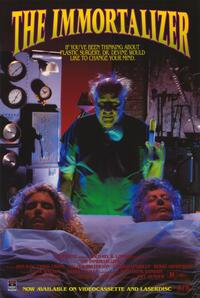
Let me be frank. The Immortalizer (1989) is garbage. It's not fun, funny, or otherwise redeemable in any way. Even the nice gore effects cannot make this crap variant on Re-Animator any good at all.
The basic premise: a mad doctor offers senior citizens the chance to be young again. How? He has an army of zombies go out and kidnap hot young people, drugs them, then transplants the old brains into the young bodies.
But it's dumb. It's very dumb, and also sadistic. The mad doctor gleefully watches people being tortured to death on his closed-circuit camera as wobbly music warbles on in the background.
There is nothing appealing about this one, even for fans of D-grade schlock horror. Just zombies attacking people, old people getting brains removed, doctor being hideous, young people panicking as they are kidnapped and forced into surgery, lather, rinse, repeat.
The worst is when the movie tries to get serious about the whole topic of old-people-in-new-bodies, and the "characters" attempt to speak with any coherence or purpose. It falls extremely flat. These poor actors might not be so bad in other roles, I didn't even bother to research them, but I can tell you that this script is just dreck and gives them no opportunities for even basic expression.
Eventually guns and cattle prods go off, the cast is reduced one by one, and the shambling semblance of a "plot" disintegrates back into the slime from whence it came. Ugh, this movie left a bad taste in my mouth. Tomorrow night I promise much better fare.